Parker AC30 Variable Frequency Drives: Flexible Motor Control for Industrial Applications
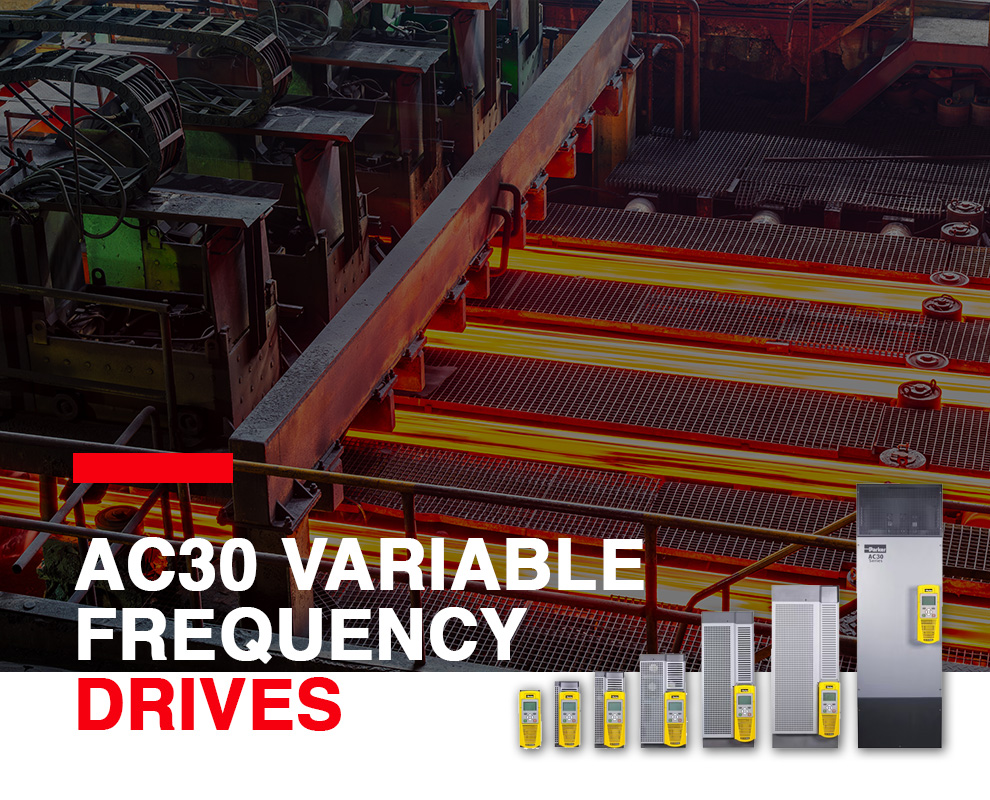
Industrial companies need reliable and accurate control of electric motors. The speed, torque and operating conditions of a motor directly affect production quality, energy consumption, equipment life and maintenance requirements. A variable frequency drive makes it possible to adjust motor operation to the actual requirements of a process.
The Parker AC30 variable frequency drive is designed for both straightforward and advanced motor-control applications. It can be used for open-loop operation, closed-loop control, standalone machines and integrated automation systems. With a broad power range, modular configuration, industrial communication options and integrated programming functions, the AC30 Series can support many different machine and process requirements.
Parker AC30 variable frequency drives are available from A&C Engineering, a Parker distributor with experience in industrial automation and drive technology.
Already know the part number? Request a quote directly.
What is a Parker AC30 variable frequency drive?
A variable frequency drive, also called a VFD, frequency inverter or variable speed drive, controls the speed and torque of an AC motor by changing the frequency and voltage supplied to that motor.
Without a variable frequency drive, a motor often operates continuously at its rated speed. Mechanical components such as valves, dampers, gearboxes or brakes may then be used to regulate the process. This can result in unnecessary energy consumption, mechanical wear and limited process control.
The Parker AC30 drive adjusts motor output electronically. The motor can therefore run at the speed required by the application. This supports controlled starting and stopping, accurate speed adjustment, process regulation and reduced energy use.
The AC30 Series is suitable for open-loop pumps and fans as well as closed-loop production-line applications. Depending on the selected control module and feedback options, the drive can control AC induction motors and permanent-magnet AC motors.
Power range for small and large industrial motors
The Parker AC30 Series covers a standard-drive power range from 0.75 kW to 450 kW. This allows the same drive platform to be used for small auxiliary motors and large production equipment.
The drives are intended for three-phase power supplies from 380 to 480 VAC, with normal-duty and heavy-duty ratings available. The correct rating depends on the motor, load profile, overload requirements, operating environment and application.
Normal-duty ratings are commonly used for variable-torque loads, such as pumps and fans. Heavy-duty ratings are relevant for applications that require more starting torque or higher overload capacity. Examples include conveyors, hoists, extruders, machine spindles and processing equipment.
Selecting a Parker AC30 variable frequency drive should always be based on the complete application data. Motor power alone is not sufficient. Motor current, overload conditions, ambient temperature, enclosure design, braking requirements and control method must also be considered. A&C Engineering can assist with selecting a suitable AC30 configuration.
 Modular Parker AC30 drive configuration
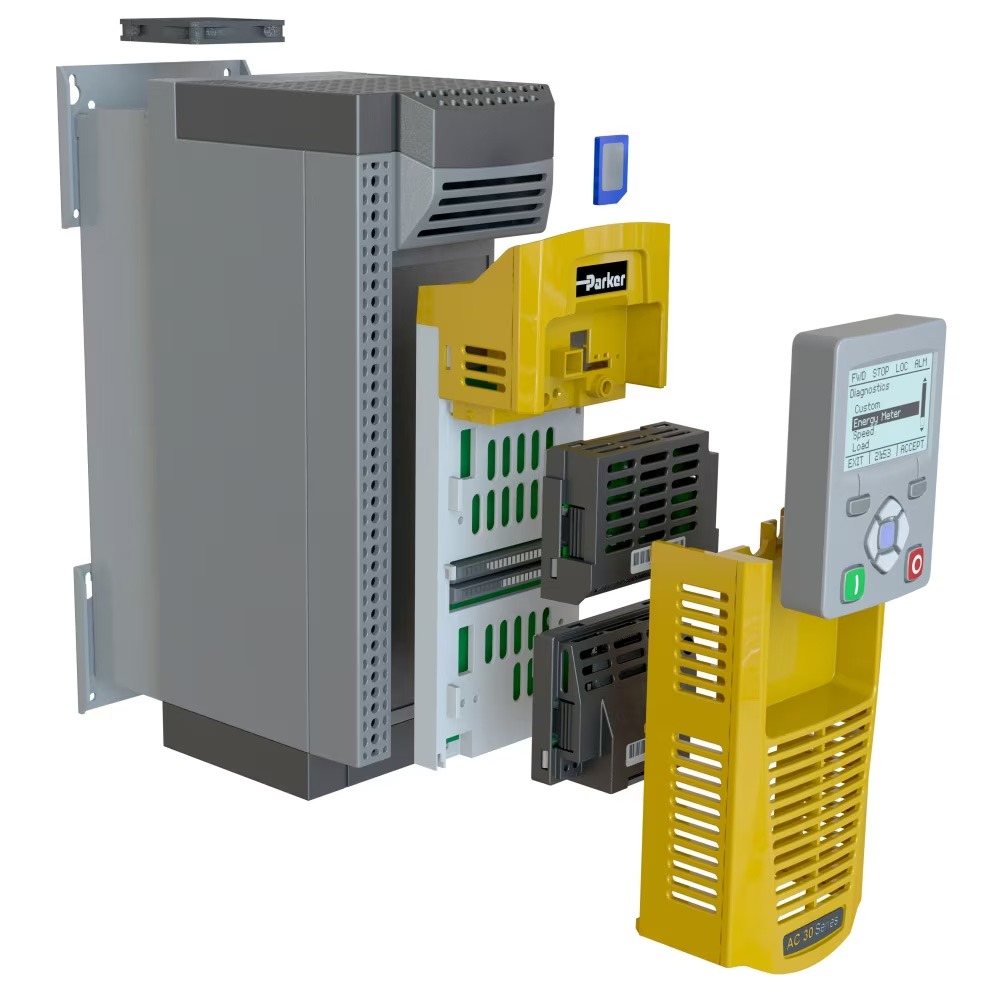
One of the main characteristics of the Parker AC30 Series is its modular construction. A system can be configured by selecting the required power stack, control module, communication options, I/O modules and accessories.
This modular design helps companies specify the functions they need without installing unnecessary hardware. It also makes it possible to use a consistent drive platform across several machine types.
The AC30 Series includes four main control-module variants:
AC30V for standalone applications
The AC30V is the base control module for standalone applications. It supports application macros, Safe Torque Off, Modbus server functionality, a basic web server and programming with Parker Drive Quicktool.
Although it is suitable for pump and fan control, the AC30V is not limited to these applications. Its program can be modified to match the control requirements of a specific machine. Configurations can also be transferred using an SD card, which is useful when several identical drives need to be commissioned.
AC30P for networked automation
The AC30P adds advanced connectivity and system functionality. It supports communication through Modbus TCP/IP, PROFINET and EtherNet/IP. Dual Ethernet ports make it suitable for networked systems and multiple-drive configurations.
The AC30P can also support time-synchronised peer-to-peer communication. This is relevant when drives must exchange operational data or coordinate their movement within a production system.
AC30D for dual-encoder applications
The AC30D includes the features of the AC30P and adds dual-encoder inputs and a programmable encoder output. It is suitable for applications that require phase locking, an electronic line shaft or coordinated operation between several drive axes.
The additional encoder connections also leave the main I/O expansion position available for other application-specific options.
AC30A for absolute-position control
The AC30A is intended for absolute-position and high-speed applications. It supports EnDat 2.1-compatible sin/cos encoders and includes encoder-repeat functionality and additional digital I/O.
This version is relevant for machines that require accurate position information and advanced motor feedback.
Download the AC30 Variable Speed Drive Catalog
Industrial communication and system integration
Modern frequency inverters must exchange information with PLCs, HMIs, supervisory systems and other drives. The Parker AC30 variable frequency drive supports several methods of integration.
Modbus TCP/IP is available across the AC30 control-module range. Depending on the selected module, PROFINET and EtherNet/IP are also available. Additional fieldbus and communication modules can be installed when required.
The drive also provides analogue and digital inputs and outputs. These can be used for speed references, sensor signals, run commands, alarms, relay functions and process feedback. Optional I/O modules expand the number and type of available connections.
This flexibility allows an AC30 drive to operate in several configurations:
- As a standalone motor controller
- As part of a PLC-controlled machine
- In a Parker PAC and HMI network
- In an automation system with third-party controllers
- In a coordinated multi-axis drive system
- In a common DC-bus installation
The integrated Ethernet connection can also provide access to diagnostic web pages and drive parameters. Maintenance personnel can use this information to check drive status and support fault analysis.
Programming with Parker Drive Quicktool and Parker Drive Developer
The Parker AC30 Series supports two main software environments.
Parker Drive Quicktool, or PDQ, is designed for installation, commissioning, parameter adjustment and drive monitoring. The software detects AC30 drives connected to the Ethernet network. A commissioning wizard guides the user through application selection, motor data, I/O configuration and communication settings.
PDQ is suitable when a standard motor-control application needs to be configured efficiently. Parameters can be monitored, adjusted and displayed in charts.
Parker Drive Developer, or PDD, is a more advanced programming environment. It supports the IEC 61131 programming languages, including ladder logic, structured text and function-block diagrams.
PDD gives programmers access to drive parameters and application functions. It can be used to create custom parameters, menus and control logic. In some applications, the integrated PLC functionality can reduce or remove the need for a separate PLC.
Parker supplies application libraries and predefined functions for tasks such as basic speed control, pump and fan control, winder functions and cascaded pump systems.
Application macros for faster commissioning
Application macros provide predefined control structures for common motor-control tasks. Instead of developing the complete logic from the beginning, the engineer enters the data required for the application.
Available functions include:
- Basic speed control
- Automatic and manual control
- Preset-speed selection
- Raise and lower speed commands
- PID process control
- Torque control
- Pump control
- Hydraulic-pump control
Additional functions support specific pump and fan requirements. These include belt-breakage detection, control of a rotating load, intelligent pump profiles, skip frequencies and timed operation.
Multiple PID loops can be programmed to control variables such as pressure, flow and temperature. Maintenance timers can also generate messages based on accumulated operating hours.
Energy-efficient control of pumps and fans
Pumps and fans are often selected with additional capacity to ensure that a system can meet its maximum demand. When the motor runs continuously at full speed, flow may be regulated with a valve or damper. The motor then continues to consume more energy than required by the process.
A Parker AC30 drive for pumps and fans adjusts motor speed to match the required flow or pressure. Reducing motor speed can significantly reduce the power required by variable-torque loads.
According to Parker’s AC30 catalogue, a speed reduction of 20 percent can reduce energy consumption by almost 50 percent in an appropriate pump or fan application. The actual saving depends on the system design, operating hours, load profile, motor efficiency and existing control method.
Variable-speed operation can provide additional practical benefits:
- Lower electricity consumption
- Improved process control
- Reduced mechanical wear
- Lower maintenance requirements
- Quieter operation
- Reduced starting current
- Longer equipment life
- Reduced carbon emissions associated with electricity use
A detailed assessment is required to determine the potential saving for a specific installation.
Designed for industrial operating conditions
Industrial frequency inverters may be exposed to heat, vibration, dust and chemically active substances. The AC30 is conformally coated as standard and is designed to meet several environmental classifications.
Its cooling design separates the power-stack airflow from the control electronics. This helps reduce contamination of sensitive components. The fan is removable to support maintenance, and through-panel mounting is available for several frame sizes.
The AC30 Series also offers internal EMC-filter options and includes DC-link chokes above specified power ratings to help reduce harmonics. Marine and offshore certification is available for applicable drive sizes, making the range suitable for selected marine systems and offshore equipment.
Applications for Parker AC30 variable frequency drives
The combination of open-loop control, closed-loop feedback, industrial communications and programmable functions makes the AC30 suitable for many applications.
Typical uses include:
- Industrial pumps
- Fans and ventilation systems
- Packaging machines
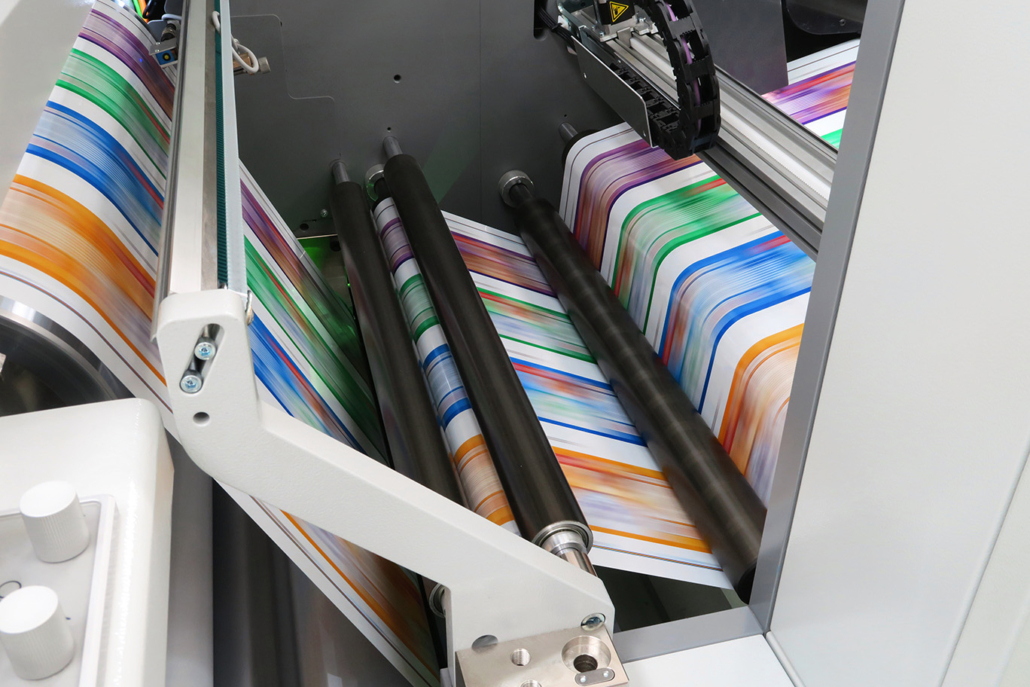
- Printing machines
- Converting machines
- Textile machinery
- Extruders
- Rolling mills
- Test stands
- Machine spindles
- Hydraulic power units
- Crane and hoist equipment
- Marine winches
- Wire-drawing machinery
- Coordinated production lines
The correct control module and power rating will vary by application. A pump installation may require the AC30V with PID control, while a coordinated process line may require an AC30P or AC30D with Ethernet communication and encoder feedback.
Common DC-bus and regenerative configurations
For multi-drive installations, the AC30 Series can be configured in a common DC-bus system. Drives can share energy through the DC link, which may reduce the need for individual braking resistors.
Parker also describes an Active Front End configuration for applications with substantial regenerative energy. An Active Front End can return energy to the electrical supply instead of dissipating it through braking resistors. It can also support low harmonics, power-factor control and voltage-boost functions.
Common DC-bus and Active Front End systems require detailed electrical engineering. Drive ratings, protection, input components, braking requirements and system limits must be assessed before installation.
Parker AC30 variable frequency drives from A&C Engineering
A variable frequency drive must be matched to the motor, machine and operating environment. Selecting the correct AC30 model involves more than choosing a kilowatt rating. The control-module version, communication protocol, feedback method, I/O requirements, enclosure, overload rating and accessories also need to be specified.
As a Parker distributor, A&C Engineering supplies Parker AC30 variable frequency drives for industrial motor-control applications. A&C Engineering can help identify a configuration that meets the technical requirements of your machine or process.
Contact A&C Engineering for information about:
- Parker AC30 drive selection
- AC30V, AC30P, AC30D and AC30A control modules
- Motor and application requirements
- Communication and I/O options
- Encoder and resolver feedback
- Pump and fan control
- Multi-axis drive systems
- Replacement or modernization projects
- Commissioning and technical support
Choose the correct Parker AC30 drive for your application
The Parker AC30 variable frequency drive combines a wide power range with modular hardware, programmable control, industrial Ethernet communication and integrated safety functionality. It can be configured for basic speed control, process regulation, closed-loop operation and coordinated multi-drive systems.
For companies looking for an energy-efficient variable frequency drive for industrial motors, the AC30 Series provides several configuration options within one product platform.
Parker AC30 variable frequency drives are available at A&C Engineering. Contact A&C Engineering to discuss your motor data, power requirements, control method and communication needs.